

Short answer
Most residential wine cellars need 1,000 to 4,500 BTU/hr of cooling. The exact number depends on five things: how big the room is, how well it’s insulated, how much glass you have, how many bottles you’re cooling down at first stock-up, and the temperature on the OTHER side of every wall.
A 600 cu ft wine room with R-19 walls and an insulated wood door usually lands around 1,500 BTU/hr. A 1,500 cu ft cellar with a glass wine wall can easily push 3,500 BTU/hr or more. Below, we walk through the actual formula so you can run the math on your own room — or download our free Excel calculator and have it done in two minutes.
Free download: Wine Cellar Heat-Load Calculator
The full 5-component formula in a Microsoft Excel workbook. Yellow cells for your inputs, red cell for your answer in BTU/hr. No email required.
Why a wine room is different from a regular room
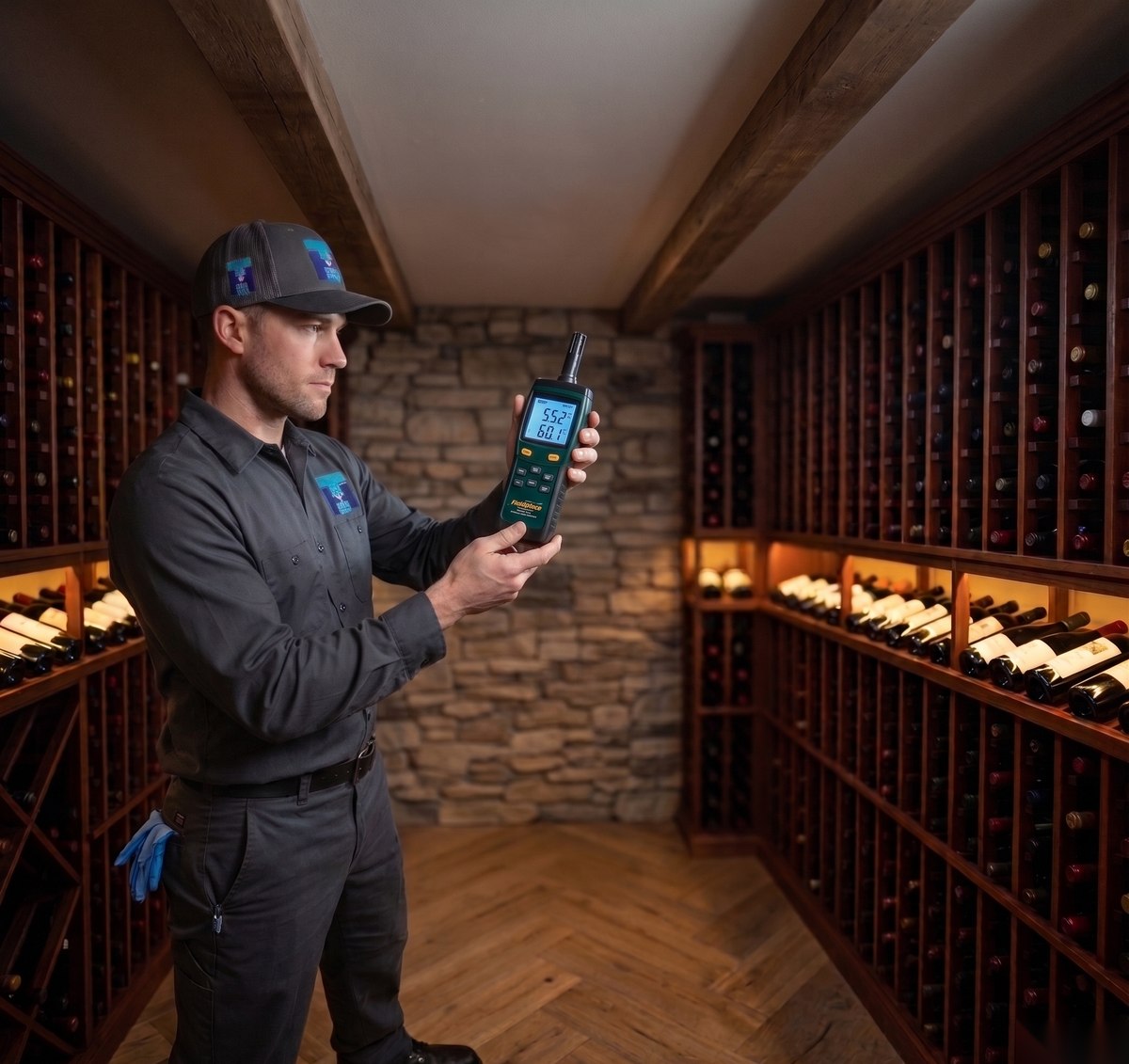
Before we get to the math, here’s the part most homeowners (and a lot of contractors) get wrong: a wine cellar is a refrigeration problem, not an air-conditioning problem.
Your home’s central AC is engineered to drop 78°F room air down to about 72°F. To do that, the cooling coil itself runs at maybe 55-58°F — cold enough to do the job, but warm enough that it doesn’t yank too much moisture out of the air.
A wine cellar needs the room ITSELF at 55°F, with relative humidity held between 60% and 70%. If you point a regular mini-split at that target, the indoor coil has to run at 35-40°F to pull room air down that low. At 35-40°F, every gram of moisture in the air condenses out on the coil and runs down the drain. Within a week or two of operation, your cellar’s humidity collapses to 30% or lower — and corks start drying, labels shrink, and your bottle investment is at risk.
Purpose-built wine cellar refrigeration units solve this with a low-TD coil: the temperature difference between the room and the coil is engineered down to about 8-10°F (instead of the 18-22°F TD you’d see on a residential mini-split). The result — same 55°F room, but the coil is gentle enough to hold humidity in the 60-70% range without dripping the room dry.
This is why we always lead with the same message when a homeowner calls: don’t even think about a regular mini-split. The equipment category matters more than the BTU number.
The 5-component heat load formula
Whether you’re using our calculator or sketching the math on a napkin, every legitimate wine-cellar sizing exercise covers the same five buckets. Skip any one of them and you’ll undersize the unit.
1. Transmission — heat conducting through walls, ceiling, and door
Every surface of your cellar has heat conducting through it from the warmer rooms around it. The math is identical to what an HVAC engineer would do for any cold-storage box:
Where U is the inverse of the surface’s R-value (1/R), A is the area in square feet, and ΔT is the temperature difference between the cellar (55°F) and the air on the other side of that surface. For a basement cellar adjacent to a 75°F basement living room, ΔT is 20°F. For an upstairs cellar against a 90°F summertime garage, it’s 35°F.
Rule of thumb: R-19 walls (typical 2×6 with fiberglass) are bare minimum. R-30 ceilings and walls are recommended. If you have any uninsulated wall, expect to bump your BTU number by 15-40%.
2. Infiltration — outside air leaking in
No cellar is perfectly sealed. Air leaks in around the door, through wall penetrations, and even through the vapor barrier. Industry standard for a well-built residential cellar is 0.5 air changes per hour (ACH). That outside air arrives warm AND humid, so it loads the system in two ways:
Qlatent = (humidity load — calculated separately)
For a 600 cu ft cellar with 25°F ΔT, that’s about 135 BTU/hr of sensible infiltration alone. Skip a vapor barrier and you can easily double this number.
3. Product — cooling warm bottles down on first fill
Here’s the load most homeowners forget. The day you fill the cellar, every one of those bottles is at room temperature — call it 70°F. The refrigeration unit has to pull all of them down to 55°F, and you want that done within 48-72 hours. Pulling 500 bottles down in 72 hours requires meaningful BTUs:
Wine has a specific heat of about 0.9 BTU/lb·°F. A standard 750 mL bottle weighs roughly 2.65 lb. So 500 bottles dropping 15°F over 72 hours = 248 BTU/hr. If you’re stocking 2,000 bottles all at once, that climbs to nearly 1,000 BTU/hr of dedicated product load — not optional.
4. Internal loads — lights, the evap fan, and door openings
Every watt of electrical energy that’s consumed INSIDE the cellar ends up as heat in the cellar. Three big ones:
- Lighting. LED is mandatory in a wine room — incandescent and halogen put off five to ten times more heat for the same light output. Even with LED, account for it: 50 W of light running 2 hours a day = about 14 BTU/hr.
- The evaporator fan motor. This is the one that surprises people. The wine cellar unit’s indoor fan is inside the cellar, runs continuously, and converts every watt of motor power directly to heat. A typical 50 W fan adds 170 BTU/hr around the clock. That’s bigger than the entire lighting load.
- Door openings. Each time the cellar door opens, a slug of warm room air pours in. Four openings per day on a 600 cu ft room = roughly 60 BTU/hr averaged out. More if you entertain heavily.
5. Safety factor — 10 to 15 percent on top
Industry standard is to add a 10-15% safety factor to the total. The reasoning:
- Coil performance drops about 10% over 5 years as dust and biofilm build up on the fins.
- Real-world infiltration usually drifts upward as door seals age.
- Most homeowners eventually add bottles, racking, or a humidifier they didn’t plan for.
Skip this and a unit that’s “exactly sized” today will be undersized in three years.
Worked example: a real 600 cu ft basement wine cellar
Let’s run the math on a typical project we’d quote in the East Metro. Specs:
- 10 ft × 8 ft footprint, 8 ft ceiling = 640 cu ft
- R-19 fiberglass batt in 2×6 framed walls, R-30 in ceiling
- Insulated solid wood door, no glass
- Adjacent basement living room at 80°F worst-case = ΔT 25°F
- 500 bottles at initial stock-up, pulled to 55°F over 72 hours
- 50 W of LED lighting, 2 hours/day
- 4 door openings per day
| Component | BTU/hr |
|---|---|
| 1. Transmission — walls (R-19) | 353 |
| 1. Transmission — ceiling (R-30) | 67 |
| 1. Transmission — insulated wood door | 250 |
| 2. Infiltration — sensible | 144 |
| 2. Infiltration — latent | 13 |
| 3. Product cooldown (500 bottles in 72 hr) | 248 |
| 4. Lighting (50 W LED, 2 hr/day) | 14 |
| 4. Evaporator fan motor (50 W continuous) | 171 |
| 4. Door openings (4/day) | 58 |
| Subtotal | 1,317 |
| 5. Safety factor (15%) | 198 |
| REQUIRED COOLING CAPACITY | 1,515 BTU/hr |
That 1,515 BTU/hr number maps cleanly to a small through-the-wall self-contained unit — something like a WhisperKOOL SC PRO 2000 or a Wine Guardian D025 series, both rated around 1,700-2,000 BTU/hr at standard conditions (55°F supply / 85°F ambient).
Picking the right equipment category
Once you have your BTU number, the install category usually picks itself based on three constraints: where the condenser can go, how loud the cellar can be, and how much wall space you have.
Through-the-wall self-contained (under 1,500 BTU/hr)
One box mounted in the wall, like a window AC for a wine room. Evaporator on the cellar side, condenser on the outside-the-cellar side. Cheapest install. Limited by needing an adjacent room that’s at least 600 cu ft (the dump space for the condenser heat). Examples: WhisperKOOL SC, Wine Guardian D-series, Breezaire WKE.
Ducted split (1,500-4,500 BTU/hr)
Evaporator hidden in a soffit or mechanical room above the cellar, condenser outdoors or in an attic. Air is ducted in and out of the cellar through grilles. Quietest option — no fan noise inside the cellar. Best for finished spaces where you don’t want to see the equipment. Examples: Wine Guardian DS-series, CellarPro VS-series.
Ductless split (1,500-6,000 BTU/hr)
Wine-rated mini-split with low-TD coil. Indoor head mounted in the cellar, condenser outside. Higher capacity than through-wall, and you don’t need an adjacent dump space. Slightly noisier than ducted because the fan head is right in the cellar. Examples: Wine Guardian DS series, CellarPro 8000S.
Multi-unit or engineered systems (above 5,000 BTU/hr)
Large cellars (over 2,000 cu ft, or full glass walls) often need two units running in lead/lag, or a fully engineered refrigeration package with a separate condensing unit, custom evap, and humidification built in. This is the territory where you call us before you finalize the room design.
Minnesota-specific: don’t forget the humidifier
Here’s a wrinkle that bites Twin Cities wine cellars every January. From November through March, outdoor air in the Minneapolis-St. Paul metro typically holds about 5-10 grains of water per pound — bone dry. Even with a low-TD coil and a tight cellar, that dry air infiltrates and your cellar humidity will drift toward 40-45% RH by the deep cold.
Two fixes, in order of cost:
- Lava rock or open water trays on the cellar floor. Cheap, passive, OK for small cellars under 400 cu ft.
- Stand-alone ultrasonic humidifier with built-in humidistat. We typically spec a Wine Guardian H-100 or H-200 alongside the cooling unit. Adds about $700-1,200 to the project but holds humidity within 5% of setpoint year-round.
For any cellar over 600 cu ft in the East Metro, plan on the dedicated humidifier from the start. It’s much cheaper to wire it in during the build than to retrofit it later.
Frequently asked questions
Can I just use a window AC unit?
No. Window units are designed to drop room air from 80°F to 72°F, not 55°F. The thermostat won’t go that low, and even if you bypassed it, the coil isn’t engineered to run at the temperatures required — you’ll freeze it solid within hours and the compressor will fail.
What about a regular ductless mini-split? They go down to 60°F.
Some of the newer Mitsubishi and Daikin mini-splits will accept a 55-60°F setpoint, but the coil still runs an 18-22°F TD. That’s a humidity disaster for wine. You’ll hold temperature but your cellar will run at 30-35% RH and corks will dry within months.
How big a unit do I need for 1,000 bottles?
1,000 bottles by itself isn’t a sizing input — it’s the room geometry that drives the math. But a “1,000-bottle cellar” usually translates to about 600-800 cu ft of well-insulated space, which lands in the 1,500-2,500 BTU/hr range depending on glass and door situation.
Should I oversize the unit to be safe?
No. An oversized wine cellar cooling unit cycles too quickly, never runs long enough to pull humidity into the right band, and leaves the cellar swinging between 55°F bone-dry and 58°F clammy. Properly sized + a 10-15% safety factor is the goal.
What’s the lifespan of a properly sized unit?
A correctly sized, well-maintained wine cellar cooling unit will run 10-15 years residentially. The two killers are heat (condensers cooking in 110°F attics) and dirt (filters and coils that never get cleaned). Both are preventable.
Need a wine cellar sized in the Twin Cities?
T&H Mechanical has spec’d wine refrigeration for homes across the East Metro since 2014. We’ll run the heat-load calc, recommend the right equipment category, and handle the install — cooling unit, ductwork, humidifier, and humidity-rated controls.
