
Walk-In Freezer Construction: Panels, Doors, Floors & Refrigeration
A field guide to how a commercial walk-in freezer is actually built — from a 6×6 ft restaurant box to a cold-storage warehouse — and the details that decide whether it lasts 20 years or rots in three.
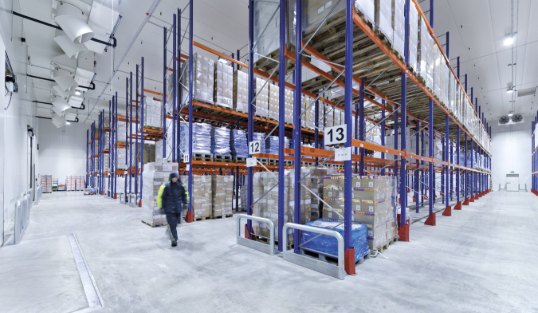
A walk-in freezer is really three systems stacked on top of each other: the envelope (insulated panels, doors, roof, floor), the vapor & frost control (sealed seams, vapor barrier, heated frames, pressure-relief vents, floor heat), and the refrigeration (the machinery that pulls heat out and rejects it elsewhere).
The single thing that separates a freezer from a cooler: everything in a freezer is fighting moisture. Below 32°F, every bit of warm, humid air that leaks in turns to ice — on the coils, in the doorway, in the floor, in the drain, in the vents. Nearly every design choice in this guide exists to manage that one fact.
A cooler forgives sloppy work. A freezer punishes it.
1. Panels & insulation — the heart of the box
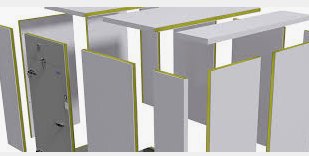
Almost every modern walk-in is built from insulated metal panels (IMPs), also called sandwich panels: an inner metal skin, a rigid foam core, and an outer metal skin bonded into one rigid structural unit. The foam carries the load between the skins, which is why a 4-inch panel can stand as a wall or span a ceiling without a separate frame.
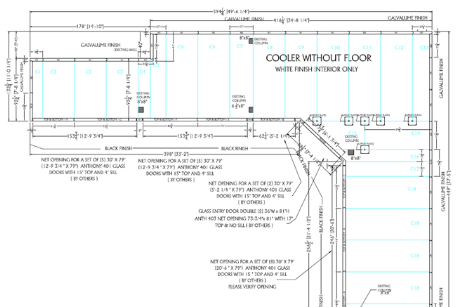
The two insulation cores — your most important materials decision
Polyurethane (foamed-in-place) gives the highest insulation per inch — roughly R-6 to R-8 per inch, so a 4″ freezer panel rates around R-32 — and makes a very rigid, strongly bonded panel. The trade-off: its R-value drifts down over time as the blowing-agent gas escapes. Extruded polystyrene (XPS) is lower up front (about R-5 per inch) but is a dense closed-cell board that resists moisture and holds its R-value far longer — in one U.S. Army Corps of Engineers study, XPS retained about 75% of its R-value over five years versus about 25% for polyurethane.
Many builders use polyurethane for walls and ceilings (strength plus R-value) and lean to XPS for the floor (moisture). Don’t confuse XPS with cheap white EPS bead-board — EPS soaks up moisture and is a poor freezer choice.
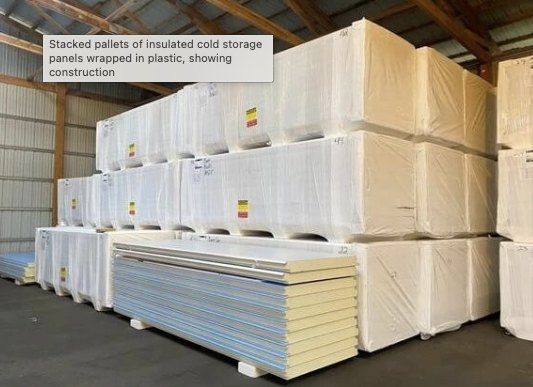
Thickness — match it to temperature
- Coolers (35–41°F): 3½″–4″
- Freezers (−10°F to 0°F): 4″ minimum, 5″ preferred in hot climates or for energy savings
- Large / low-temp cold storage: 5–6″+, and warehouse panels can run 8–12″
Rule of thumb: about R-30 for coolers, R-32+ for freezers on walls and ceilings, and higher for floors and big facilities.
Skins, cam-locks & standards
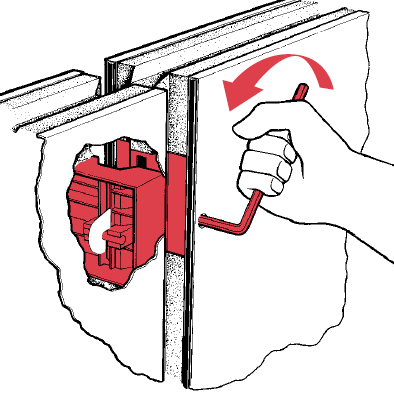
The standard skin is 26-gauge galvanized steel with a baked acrylic or stucco-embossed finish; interior food-contact surfaces are white acrylic or stainless for cleanability. Panels lock with a cam-action system built into the edges: a hex (Allen) wrench rotates a hooked cam that grabs a pin in the next panel and draws the two together into an airtight, vapor-tight joint. That’s what makes walk-ins modular — they ship flat and assemble with a hex wrench. Commercial food walk-ins must meet NSF/ANSI Standard 7 (cleanable, no exposed insulation, coved corners), are typically UL listed, and must hit U.S. DOE / ASHRAE 90.1 energy minimums.
2. Roofs & ceilings
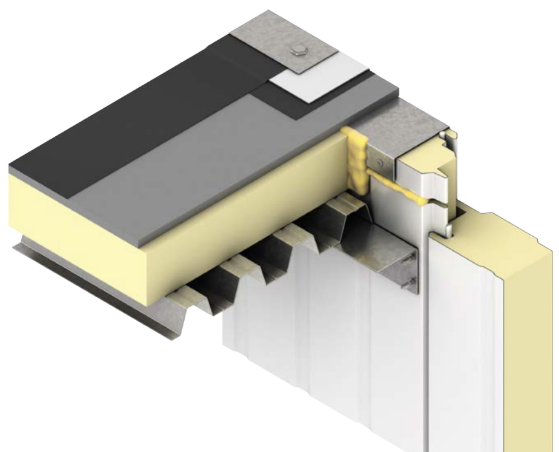
For most restaurant and mid-size boxes, the ceiling is just more panels cam-locked to the wall tops. Ceiling panels are rated for a maximum deflection of L/240 under about 15 lb/ft², and most allow an unsupported span up to roughly 12–16 feet depending on thickness. Beyond that, a suspended support system hangs the ceiling from the building structure with brackets at the panel seams. If anyone needs to walk on top to service rooftop refrigeration, specify a walkable structural ceiling — a standard ceiling panel is not meant to be walked on.
Outdoor walk-ins add a weather roof / rain cap — commonly a 40-mil UV-resistant polyester membrane with perimeter hold-down trim, sloped to shed water — plus weather-resistant skins and fully sealed seams. At warehouse scale, the building shell itself (steel structure with insulated roof and wall panels) often is the freezer envelope.
3. Floors — the most misunderstood part of a freezer
Floors are where freezers go wrong, because frozen ground is destructive and you can’t easily insulate under a box after the fact.
Three floor approaches
- Modular insulated floor panels — foam core with an aluminum or diamond-plate top skin, locked to the box like the rest of the panels. Typically handle ~500–800 lb/ft² (foot traffic, racks, pallet jacks — not forklifts). Best for restaurants, mid-size boxes, and anything installed over occupied space. A freezer essentially always needs an insulated floor, no matter where it sits.
- Insulated concrete slab — poured over a vapor barrier, rigid insulation, and a mud slab, with perimeter thermal-break strips. Handles forklift traffic and heavy point loads; standard for warehouses and production freezers, often poured flush so there’s no threshold to drive over.
- Heated or ventilated subfloor — mandatory for any freezer on grade (see below).
Frost heave — the physics you can’t ignore
A freezer on the ground slowly freezes the soil beneath it. Soil moisture turns to ice, expands, and pushes upward — frost heave — cracking the slab and buckling the floor. Insulation alone won’t stop it on grade; you have to keep the soil above 32°F.
Three ways to protect a slab-on-grade freezer:
- Sub-slab glycol (or warm-water) heating — tubing on ~24–32″ centers circulating warm fluid, ideally heated by reclaimed condenser heat you’re rejecting anyway. Preferred for large facilities.
- Electric heat cable — resistance cable with a soil sensor; economical for smaller boxes and the usual fix to save an already-heaving floor.
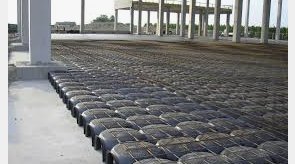
- Ventilated (air-gap) subfloor — vented pipes or void-formers on ~20″ centers let air flow under the slab so the soil never freezes; passive or fan-forced, no heating energy.
4. Doors
The door is the hardest-working, most failure-prone part of any freezer. Every opening dumps warm, moist air into a sub-freezing space, so freezer doors are engineered to seal tight, shed frost, and not freeze themselves shut.
Door styles
- Hinged / swing — the default; pre-hung, with dual compression + magnetic gaskets, a positive latch with inside safety release, and a self-closing hinge.
- Sliding (horizontal) — rides a track, saves floor space, easy with loaded carts; single or bi-parting.
- Bi-parting / bi-fold — two leaves open a wide opening fast for oversized loads and high traffic.
- Vertical-lift — travels straight up where you have ceiling height but limited wall space (dock / forklift openings).
- Roll-up / high-speed fabric — cycles fast on very high-traffic openings, usually paired with an air curtain.
Door accessories that earn their keep
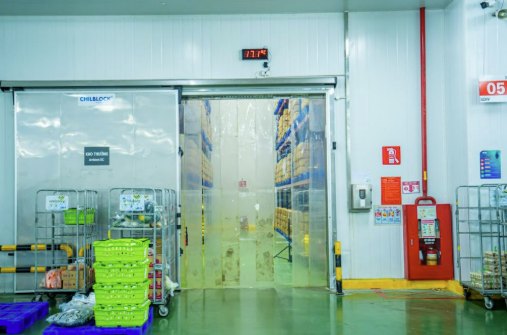
- Strip curtains — overlapping low-temp (“polar”) PVC strips that block most of the cold spill when the door is open.
- Air curtains — an overhead, often electrically heated air stream that can cut heat and moisture transfer through the opening by 60–80%.
- Auto-closers and door-ajar alarms — now effectively required by energy code; they pay for themselves in compressor runtime.
- Door / fan switch — shuts the evaporator fans off whenever the door opens, so the fans aren’t pulling warm moist air across the cold coil.
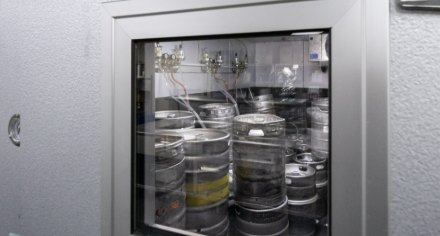
Glass display / merchandiser doors. Reach-in merchandiser freezers use glass display doors with anti-sweat heater wire around the glass and frame to keep the surface above the dew point so the glass stays clear — the same principle as the heated frame, applied to glass.
5. Sealing, vapor barriers & frost control
This is the invisible part that decides whether the box lasts 20 years or rots in three. Cam-lock joints, NSF gaskets, and food-grade sealant create an airtight, vapor-tight envelope; interior corners are coved for cleaning.
The vapor barrier goes on the WARM (exterior) side. In a freezer the vapor drive is always from warm-and-humid outside toward cold-and-dry inside, so the sealed outer skin is the barrier. A single unsealed seam or careless penetration on the warm side lets moisture ride into the panel, condense in the cold zone, freeze, and over time waterlog and delaminate the panel from the inside. That’s why every penetration — lines, drains, wiring — must be sealed.
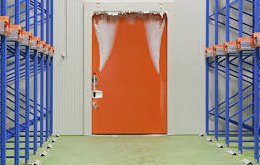
Pressure-relief vents equalize the partial vacuum created when a warm door closes and the air inside contracts (otherwise the door can be impossible to reopen). In a freezer the vent is heated so the venting moisture doesn’t ice it shut.
Every freezer-specific feature traces back to the same enemy — moisture:
| Where moisture attacks | The defense |
|---|---|
| Coil / evaporator | Defrost cycle (electric or hot-gas) |
| Doorway air spill | Strip curtain + air curtain + fast-closing door |
| Door frame & gasket | Heated frame, heated gasket |
| Pressure-relief vent | Heated relief port |
| Condensate drain line | Heat tape so it can’t freeze shut |
| Floor / ground | Sub-floor heat (glycol/electric) or ventilation |
| Inside the panel | Exterior vapor barrier + sealed seams & penetrations |
6. Refrigeration — how the cold actually gets made
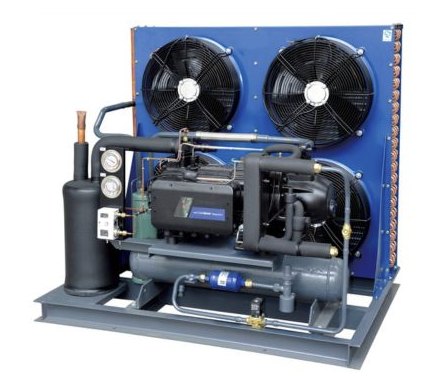
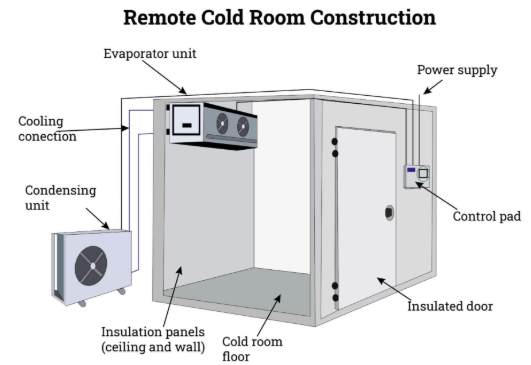
Every system has the same four parts: a compressor (pumps refrigerant), a condenser (rejects heat outside), a metering device (expansion valve), and an evaporator (the coil inside the box that absorbs heat). What changes from a small box to a warehouse is how those parts are packaged and where they sit.
Self-contained vs. remote — the fundamental fork
Self-contained (“plug-and-play”) units come pre-assembled and factory-charged, mounted on top (“penthouse”) or through the wall (side-mount). Lowest install cost, fastest, easiest to swap — but they dump condenser heat into the room the box sits in, are noisier inside, and eat usable space. Best for restaurants, small/medium boxes, and outdoor boxes.
Remote / split systems keep the evaporator inside and locate the condensing unit outdoors, on the roof, or in a mechanical room, joined by copper lines. Quieter, rejects heat outside the building, frees up interior space, and is generally more efficient — at a higher install cost. Best for larger boxes, multiple boxes, hot kitchens, and serious commercial work.
Evaporators (unit coolers) and defrost
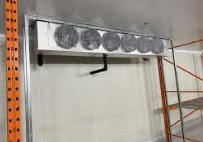
The unit cooler (coil + fans) hangs inside the box; low-profile units save headroom, large-face units move more air. Freezer coils run below freezing and build frost from any moisture, which insulates the coil and chokes airflow — so freezers must defrost on a schedule. Coolers above ~35°F often get by on simple off-cycle / air defrost; freezers cannot.
- Electric defrost — embedded heater rods melt frost on a timer. Simple, reliable, most common; downside is some heat ends up as load inside the box.
- Hot-gas defrost — diverts hot compressor discharge back through the coil to melt frost from the inside out. Faster and more efficient; standard on large / industrial systems.
Refrigerants — what’s used and what’s changing
Legacy R-404A is being phased down for high GWP. Common replacements today are R-448A and R-449A (note their temperature glide and higher discharge temps). Natural refrigerants are the future: R-290 (propane) in small self-contained units (charge-limited because flammable), CO₂ (R-744) transcritical for large supermarket and cold-storage systems, and ammonia (R-717) — the industrial workhorse for big warehouses, extremely efficient but toxic and requiring trained operators and strict safety compliance.
Secondary / glycol systems (large facilities)
Big plants often keep the toxic or flammable primary refrigerant contained in one machine room and pump a secondary fluid — glycol, CO₂, or brine — out to the rooms and blast cells. The same secondary loop can feed under-floor heating, door-jamb heating, and defrost. Blast freezers (rapid product freezing) are usually part of these central systems because of their huge peak loads.
7. Sizing, climate & load — getting capacity right
Don’t eyeball this. Sizing is a heat-load calculation that adds up every source of heat the system must remove: conduction through walls/ceiling/floor; product load (cooling and freezing incoming product — the latent freezing load is huge); infiltration from door openings; internal gains (fan motors, lights, defrost heaters, people); a 10% safety factor; and a defrost allowance.
Temperature targets
- Cooler: ~35–41°F holding
- Standard freezer: ~0°F holding, coil (suction) around −15°F to −20°F
- Deep / low-temp & blast: −10°F to −20°F (ice cream, seafood, blast freezing)
Climate matters — a lot
The outdoor ambient where the condenser rejects heat drives capacity. In hot climates, size the condenser for high ambient (95–100°F+) and prefer 5″+ panels — undersizing for ambient is the #1 hot-climate failure.
In a cold climate like Minnesota, the opposite problem bites: outdoor condensers need low-ambient head-pressure controls (fan cycling or variable-speed / flooded-head controls) so the system can build enough head pressure in winter, and outdoor lines and drains need heat trace so they don’t freeze. Get these wrong and the box short-cycles in January or the drain freezes solid.
For a same-size box, a freezer needs roughly 2–3× the BTU/hr of a cooler because of the larger temperature differential, the freezing load, and the defrost allowance. A moderately sized −10°F freezer can land in the range of ~15,000–25,000 BTU/hr — but the only number that matters is the one from an actual heat-load calc for your box, product, door traffic, and climate.
8. Scaling from a restaurant box to a warehouse
The same principles scale, but the parts get bigger and the floor, doors, and refrigeration change character at each step up.
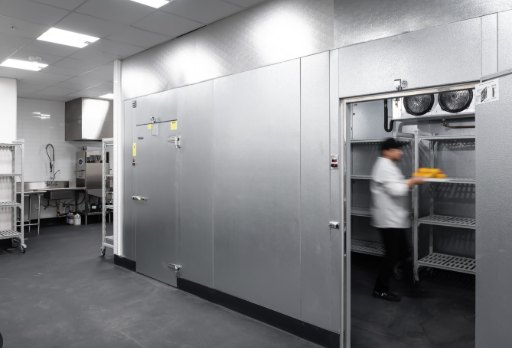
Small restaurant freezer
4″ modular cam-lock
Insulated panel floor (no separate floor heat needed), a hinged door with a strip curtain, and a self-contained top- or side-mount unit on R-290 or R-448A/449A. Plug-and-play and easy to swap.
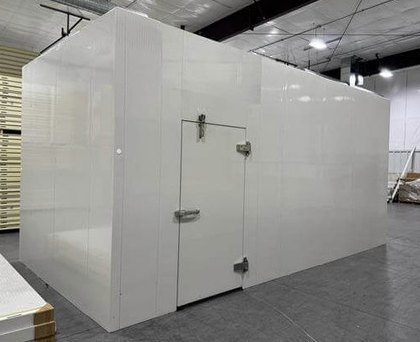
Mid-size commercial
4–5″ modular
Panel or insulated slab floor, hinged or sliding doors with an air curtain, and a remote / split air-cooled system on R-448A/449A or CO₂. Sub-floor heat sometimes required.
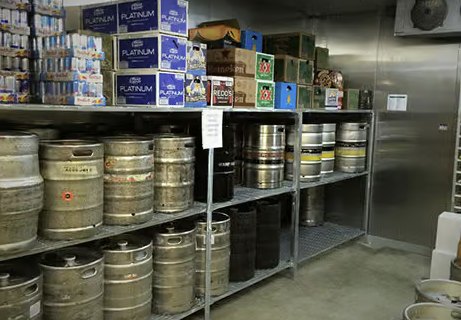
Large cold storage
5–12″ IMP
Insulated slab with mandatory sub-floor heat or ventilation, bi-parting / vertical-lift / high-speed doors with dock seals, and a central ammonia or CO₂ plant with glycol secondary and hot-gas defrost.
The installer’s don’t-get-burned checklist
- Always insulate the freezer floor. No exceptions.
- On grade? Add heave protection — glycol (ideally heated by reclaimed condenser heat), electric cable, or sub-floor ventilation.
- Vapor barrier on the warm side, and seal every seam and penetration.
- Size for the climate’s ambient, not just box volume.
- Oversize for defrost — the unit can’t run 24 hours.
- Spec the door heaters and heated relief vent — and when you see doorjamb frost, check those heaters first.
- Heat-trace the condensate drain.
- Use freezer-grade strip curtains and add an air curtain on high-traffic openings.
- Add auto-closers and door alarms.
- Plan for the refrigerant transition — R-404A is on the way out; new builds should be R-448A/449A, CO₂, or R-290 by size.
Frequently asked questions
Does a walk-in freezer always need an insulated floor?
Yes. Unlike an indoor cooler sitting on a ground-level slab, a freezer always needs an insulated floor, and a freezer on grade also needs active frost-heave protection (sub-floor heat or ventilation). Skip it and the floor will eventually crack and buckle.
What temperature should a walk-in freezer hold?
Most run at about 0°F, with the evaporator coil around −15°F to −20°F. Deep-freeze and blast applications (ice cream, seafood) run −10°F to −20°F.
Why does my freezer door keep frosting up or freezing shut?
Almost always a failed door frame heater or heated pressure-relief vent. Those heaters keep the frame above the dew point so the gasket doesn’t freeze to the frame and the relief vent doesn’t ice over. Frost around the jamb is the tell.
Self-contained or remote refrigeration — which should I choose?
Self-contained is cheapest and simplest for small boxes and outdoor installs, but it dumps heat into the room and is noisier. Remote / split is quieter, more efficient, frees up interior space, and rejects heat outside — better for larger boxes, multiple boxes, and hot kitchens.
What refrigerant will new walk-in freezers use?
R-404A is being phased down. New systems use R-448A/R-449A, propane (R-290) in small self-contained units, CO₂ in large systems, and ammonia in industrial cold storage.
T&H Mechanical has built, serviced, and troubleshot commercial refrigeration across the East Metro and Western Wisconsin since 2003 — restaurants, liquor stores, c-stores, and cold storage.
(651) 413-3331Commercial Refrigeration & HVAC · East Metro & Western WI
